
National Archives of Australia acknowledges the traditional owners and custodians of Country throughout Australia and acknowledges their continuing connection to land, sea and community. We pay our respects to the people, their cultures and Elders past, present and emerging.
Introduction from the Director-General
National Archives of Australia (National Archives) is trusted with preserving and protecting the records of the Australian Government that have enduring value for our nation. These records belong to all Australians and tell the story of who we are, capturing the decisions, experiences and events that have shaped Australia and its people. As the recognised authority on Australian Government information management, we play a vital role in preserving and sharing this documentary heritage, strengthening trust in our democracy, and supporting transparency, accountability and informed decision-making across government and the broader community.
National Archives is in a period of assessment, validation and reform, seeking to harness new
opportunities while responding to existing and emerging challenges through our 4 strategic pillars – Evolve, Enable, Secure and Connect. As we look to the future, we are focused on leading and supporting information management practices across the Australian Government, while safeguarding a growing and dispersed collection. We are also committed to putting people at the centre of our work by understanding the needs and expectations of those we serve and striving to deliver accessible, inclusive and meaningful services and experiences.
The Australian Government has committed to modernising the Archives Act 1983 to ensure National Archives can operate within a contemporary legislative framework. We are also engaging in consultation on the renewed National Cultural Policy and continue to embody the 5 pillars of the current policy, Revive: a place for every story, a story for every place, in all areas of our work.
We hold records that are essential for First Nations history and truth-telling. These records link Aboriginal and Torres Strait Islander peoples with historical Commonwealth records about themselves, their families and their Country. We continue working to embed cultural competence by implementing Our way: Aboriginal and Torres Strait Islander protocols and responding to the Tandanya-Adelaide Declaration. National Archives is also focused on internal cultural capability uplift to deepen staff understanding of First Nations histories, cultures and sensitivities through our dedicated Aboriginal and Torres Strait Islander Engagement team.
National Archives’ effectiveness in maintaining the archival resources of the Commonwealth relies on agency cooperation and proactive investment to improve information management practices. We will continue working to support agencies to improve their practices and capability, including through the whole-of-government information management policy, Building trust in the public record.
National Archives plays an important role in the wider Australian discourse around civics, democracy, culture and social cohesion. National Archives continues to contribute to this responsibility by sharing the diverse stories of the nation held in the national archival collection through exhibitions and associated public programs. We aim to create innovative and audience-centric programs and services to engage the public and enable access to and engagement with the collection.
National Archives is also positioning for an increasingly digital future. With most government agencies working digitally by default, National Archives must manage and archive greater volumes of digital records in an increasing range of formats. We are responding by working to increase our capacity to store digital records, and uplift our capability to accept and preserve them. We are navigating the growing use of artificial intelligence (AI) across the cultural sector, embracing the opportunities it presents to enhance discovery, description and access to large-scale collections, while remaining responsible and ethical. We recognise that AI must not undermine the rights or entitlements of individuals, compromise the integrity of records or diminish trust in the official record.
As the accountable authority of National Archives, I am pleased to present the National Archives of Australia Corporate Plan 2026–27, prepared in accordance with paragraph 35(1)(b) of the Public Governance, Performance and Accountability Act 2013, covering the periods 2026–27 to 2029–30.
Simon Froude
Director-General
National Archives of Australia
25 August 2026
About the National Archives of Australia
National Archives of Australia (National Archives) is an Australian Government entity established under the Archives Act 1983 (the Archives Act). It is a non-corporate Commonwealth entity (a listed entity) under the Public Governance, Performance and Accountability Act 2013 (PGPA Act) and an executive agency under the Public Service Act 1999.
National Archives' responsibility, as mandated in the Archives Act, is to secure, preserve and make accessible the archival resources of the Commonwealth.
Our purpose
National Archives preserves and protects records of the Australian Government that have enduring value. These records belong to all Australians, and tell our national story by documenting the decisions, experiences and events that have shaped Australia and its people.
We are the recognised authority for Australian Government information management, and by preserving and sharing records, we help strengthen trust in our democracy and support transparency and accountability across government.
Our work also reflects the 5 pillars of the National Cultural Policy – Revive: a place for every story, a story for every place. We do this by caring for the collection, and through our reference services, exhibitions, events and education programs, we help people connect with the records that deepen understanding of the present and inspire the future.
Strategy 2025–2030: Evolving National Archives (Strategy 2025–2030) sets a 5-year strategy towards realisation of a vision for an open, valued and trusted National Archives.
Key activities
National Archives, and Strategy 2025–2030, sets 3 key activities to achieve our purpose:
1. Enable: Provide strategic leadership in best practice information management by Australian Government entities.
We are trusted information management advisers to Australian Government agencies. We work with them to create, retain and ensure the accessibility of Commonwealth records to strengthen government integrity and accountability. We:
- lead whole-of-government information management policy, through implementation of the Building trust in the public record policy
- set whole-of-government information management standards, ensuring information management products, advice and guidance are fit for purpose now and into the future
- assist Australian Government agencies in compliance with the Archives Act and assess information management maturity across the Australian Government through the Check-Up survey.
2. Secure: Manage an evolving collection of nationally significant Australian Government information.
We are leaders in archival practices in the preservation of Commonwealth records of enduring significance and we also authorise the disposal of records with no ongoing value to government or community. We:
- work with Australian Government agencies to identify physical and digital records of enduring national significance and facilitate their transfer to National Archives
- identify and prioritise the digitisation of records that are at risk of loss or damage, in particular records of importance to First Nations peoples
- provide stewardship of the nation’s evolving archival collection.
3. Connect: Foster access and engagement between people and the national archival collection.
We make the national archival collection discoverable and accessible to the public, to enrich and inform Australians about who they are. We:
- create innovative and audience-centric programs and services to engage the public and create awareness of the national archival collection
- deliver timely and appropriate access to the national archival collection by applying effective description practices, providing research services and making timely decisions on applications for access
- connect First Nations peoples with the national archival collection in a safe and culturally appropriate way.
National Archives also undertakes activities as outlined by the Minister for the Arts' Statement of Expectations, which is published on our website, along with our Statement of Intent.
Our values
Together with the APS Values and APS Code of Conduct, Our Values guide us in all that we do.
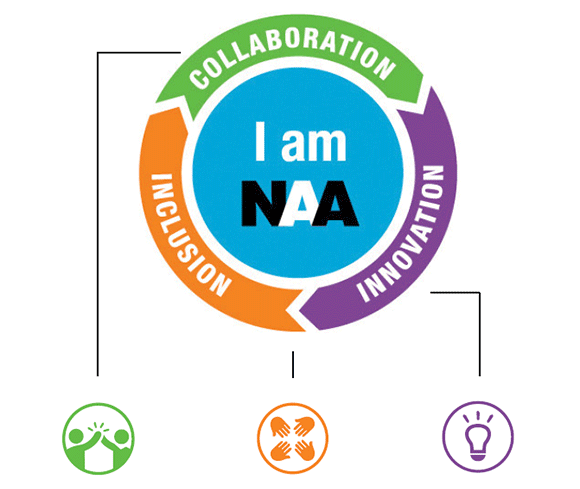
| Collaboration | Inclusion | Innovation |
|---|---|---|
|
I will trust my colleagues and make decisions together I will communicate and consult regularly and early within and across teams I will develop my knowledge of and connections with other teams |
I will respect my colleagues for who they are I will contribute to an environment where each person can make a difference and grow I will listen to the experience and knowledge of my colleagues |
I will build on our history, past successes and challenges I will be curious and suggest new ideas and opportunities for change I will experiment and use failure as an opportunity to learn |
Commitment to National Cultural Policy
Revive: A place for every story, a story for every place
The work of National Archives is embodied in the 5 pillars of the National Cultural Policy, Revive, and we will continue to align our programs of work to these pillars.
1. First Nations first
We support the telling of First Nations histories and stories, and we recognise that evidence and accounts in archival records play a vital role in redress and truth-telling for First Nations peoples. We acknowledge that at-risk First Nations cultural material must be preserved for future generations.
2. A place for every story
We provide the Australian public, researchers, historians, academics and the media access to the national archival collection, to enable conversations and storytelling about our history. We recognise that archival records hold evidence of the impact of government decisions and past events, and we share those stories so that we may better understand who we are as a nation.
3. Centrality of the artist
We recognise that the national archival collection is an important resource, particularly for biographers and historians, but also for wider artistic practice. Our commitment to ensuring access to Australia’s historical and contemporary records can inspire and inform the development of future creative work.
4. Strong cultural infrastructure
We care for and protect the national archival collection, comprising over 54 million items that weave the narrative of the collective journey of the Australian people. We recognise we are part of the infrastructure that enables Australia’s cultural and creative sector to flourish. We work to make the collection accessible for the benefit of all Australians.
5. Engaging the audience
We connect with audiences in diverse ways. With offices located in each state and territory, an online and on-demand collection database, and a range of digital and touring exhibition programs, we support Australians in discovering more about their connection to the social, cultural and political changes in our society.
Operating context
Like many government agencies, National Archives is navigating external challenges, including rapid advances in technology, increased cyber security threats, a tight fiscal environment and increasing demand for services. Eroding social cohesion and reduced public trust in government also present challenges to which National Archives can respond.
We are in a period of assessing and validating the way we work, seeking to harness new opportunities and responding to existing and emerging challenges. This work is aimed at achieving a leading and robust information and archival service that effectively manages government information assets and contributes to Australia's cultural identity.
Environment
A robust national archival collection is a whole-of-government responsibility and builds public trust in government
While Australian Government agencies have obligations under the Archives Act to manage their records appropriately, there is no legal requirement for them to comply with information management standards set by National Archives.
Recent Australian National Audit Office reports, royal commissions and whole-of-government inquiries have identified issues with recordkeeping in Australian Government agencies. These inquiries have also acknowledged that poor recordkeeping undermines Australians' ability to understand how government decisions were made.
National Archives' effectiveness in maintaining the national archival collection relies on agency cooperation and proactive investment to improve their information management practices. We will continue to support agencies to improve their practices and capability, most notably through the whole-of-government information management policy, Building trust in the public record.
Information management is a whole-of-government responsibility. Trust in government is linked to democratic participation, social cohesion and collaboration in tackling societal challenges. By working together and investing in information management, all government agencies can ensure that more Australians can access evidence of government decisions and improve the transparency and accountability of government.
Community expectations around access and engagement
National Archives is a vital part of the infrastructure that makes cultural memory possible. Our national stories are shaped by our histories, places, identities, languages, cultures, families and communities. National Archives endeavours to share these stories by providing access to the national archival collection.
National Archives plays an important role in the wider Australian discourse around the strength of our democracy. We strive to share the diverse stories of the nation by displaying the national archival collection through exhibitions and associated public programs. This allows us to connect with Australians to provide a forum for public engagement, strengthening social connectedness and democracy.
We continue to operate in an environment with high levels of expectations from the community and researchers around access to the national archival collection. Our responsibility to provide access also supports First Nations truth-telling, and we remain committed to providing access to records through schemes including but not limited to the National Redress Scheme, the Territories Stolen Generations Redress Scheme and the Victorian Stolen Generations Reparations Package.
Meeting community expectations around access is challenging. An accessible National Archives requires a collection that is effectively described and searchable, and accessible nationally. National Archives strives to maintain an 'always on' digital service, combined with physical locations where people can engage with our staff, which ensures equitable access to the national archival collection.
In an environment where resources are limited, we continue to deliver onsite access to records at research centres in all states and territories. We aim to provide researchers and members of the public with reference advice that enables them to undertake self-directed searches and access digital copies of records online, where possible. The process of applying for access requires National Archives to make decisions on whether a record should be open in full, open with exception or closed. National Archives works closely with agencies, particularly those in the defence and intelligence community, to provide timely advice on sensitivities within records to meet public expectations.
The ongoing expansion of the national archival collection, growing demand for access to records and increasing operating costs is placing pressure on our operating budget. We continue to look for efficiencies and reduce our costs.
Technological change and innovation
With most government agencies working digitally by default, National Archives must manage and archive greater volumes of digital records in an increasing range of formats. In response to this, we are working to increase our capacity to store digital records and uplift our capability to accept and preserve them. National Archives is also working to innovate, improve how we operate and play a leading role in developing the future digital records management practices required across the Australian Government.
The cyber security threat landscape also continues to evolve as the capability of threat actors grows. National Archives continues to proactively uplift our cyber security capabilities, implementing new controls and practices to strengthen our defences, while taking into consideration whole-of-government guidelines including the Information Security Manual, Protective Security Policy Framework and Australian Cyber Security Centre guidance.
National Archives is investing in solutions to support a more digitally empowered cultural future and recognises the growing challenges posed by digital technologies, including the protection of rights, integrity and cultural sensitivities in the digital environment. The emerging use of AI across the cultural sector presents significant opportunities, alongside significant risks. For archival institutions, AI can enhance discovery, description and access to large-scale collections, supporting broader engagement with the nation's stories.
At the same time, the use of AI must be responsible and ethical. AI must not undermine the rights or entitlements of individuals, compromise the integrity of records or diminish trust in the official record. In particular, information relating to Aboriginal and Torres Strait Islander peoples may be culturally sensitive or personal, requiring careful consideration of whether and how AI tools are applied in managing, describing or providing access to such material.
Importance of First Nations engagement
National Archives acknowledges that we hold records that are essential to First Nations history and truth-telling. These records link Aboriginal and Torres Strait Islander peoples with historical Commonwealth records about themselves, their families and their Country. National Archives will work to continue building relationships with Aboriginal and Torres Strait Islander peoples and communities, helping to strengthen connections with our services, programs and the collection.
National Archives has committed to embedding cultural competence by implementing Our way: Aboriginal and Torres Strait Islander protocols and responding to the Tandanya-Adelaide Declaration. This work will enable remodelling of archival practices to recognise and preserve First Nations culture and knowledge methods. In turn, this implementation will improve access to archival resources for people and communities for current and future generations.
National Archives' plan to engage First Nations peoples and communities includes:
- acknowledging First Nations peoples' diversity, and where possible, providing culturally safe spaces for individuals or groups to visit and view sensitive or culturally secret and sacred records
- protecting the cultural safety of our First Nations staff
- working to initiate and strength engagement with individuals, groups and communities for ongoing interaction with services and future collaboration
- continuing to work with the Healing Foundation in response to From Sorry to Action: A plan to act on Bringing them home (2026–28) so members of the Stolen Generations and their families can access government records.
National Archives' engagement activities are supported by a dedicated Aboriginal and Torres Strait Islander Engagement team. The team’s work includes ensuring we manage and engage with First Nations records in ways that align with cultural practices and community expectations. This team has increased resourcing to meet growing program and service demands, enabling longer-term operational planning and delivery of initiatives. We are also focusing on internal cultural capability uplift to deepen staff understanding of First Nations histories, cultures and sensitivities.
Capability
Our people
National Archives is a medium-sized agency with a national footprint, employing around 430 people. National Archives' workforce is highly engaged and draws on unique subject matter knowledge of both traditional and digital archival practices. National Archives is committed to supporting the continuous development of core, management and leadership skills, and to building expertise in digital preservation, archival practices and access.
To achieve the aims of Strategy 2025–2030, National Archives will work to build people capability in the following areas:
- Effective leadership and management – We will endeavour to strengthen leadership and management practices to support strategic alignment, performance, stewardship and continuous improvement across the organisation, including supporting technical leaders to transition to people leaders.
- Invest in the archival profession – We will aim to sustain and develop our archival specialists and continue our graduate program.
- Cultural competency and inclusion – We will make every effort to deepen understanding and respect for diverse cultures and perspectives, especially those of First Nations peoples, by uplifting cultural capability and embedding inclusive practices.
- Digital capability – We will strive to empower our staff to leverage best archival practice, confidently use digital tools and build further specialised knowledge relating to born-digital records to apply data-driven insights to digital archiving.
- User-centred design and service delivery – We will work towards building capability to understand, anticipate and respond to the diverse needs of our audiences. This will involve exploring options to design inclusive, inclusive, accessible and intuitive services that improve how people discover, access and interact with the national archival collection.
- Stakeholder engagement and information management leadership – We will strive to enable our staff to engage proactively with agencies, government and the public to support an uplift in information management maturity.
- Project management – We will aim to uplift capability to embed robust project management practices to ensure timely delivery of projects, optimisation of resources, and the successful preservation and accessibility of the national archival collection.
Targets under the APS Strategic Commissioning Framework
In 2026–27, in line with the APS Strategic Commissioning Framework, National Archives will continue to ensure core work across information and knowledge management is performed by APS employees. We will focus on reduced outsourcing of information and knowledge management work by working to develop foundational professional competencies, build essential workforce capabilities, and strengthen our core operational skills across archival and digital roles.
Infrastructure required to manage the national archival collection
Protecting and caring for the national archival collection requires specialised physical and digital storage. The nature of an archival collection is that it continually increases in size, meaning our storage needs are always expanding. We require and strive to maintain fit-for-purpose specialised storage facilities for both physical and digital records.
These facilities meet environmental conditions specified in industry standards for the storage of archival records, meet government security requirements, and have adequate areas for the handling of large volumes of archival records, together with dedicated laboratory spaces for the preservation and conservation of records that are at risk of deterioration. Our facilities also provide adequate office accommodation for staff and dedicated spaces for digitisation and access activities.
We have offices in each state and territory, which provide important in-person services for Australians. We will work to ensure that our state and territory offices deliver their work effectively and consistently by reviewing the model for service and program delivery.
The collection is also geographically dispersed, but we will continue to seek opportunities to optimise repositories, maximise physical storage capacity and scale digital storage in accordance with our business needs.
ICT capability requirements to provide a digital archival service
National Archives is working towards a digital-first approach in all aspects of our work, with a vision to providing a digital end-to-end service to the public. This will have unique challenges and require specific capabilities.
Key challenges and requirements are:
- Metadata management – The national archival collection is made up of a broad range of physical, digitised and born-digital records, including documents, images and audiovisual media. Managing the collection and making it accessible to the public is contingent on creating and maintaining rich metadata, allowing the collection to be described, categorised, searchable and secure. As the collection grows, we will explore emerging technologies to capture and maintain the metadata required to describe and access it more effectively.
- Enterprise workflow – Our current focus is integrating our existing systems and creating digital workflows that increase effectiveness and efficiency.
- Search and discovery – An effective search capability is integral to our ability to provide the public with access to the national archival collection from anywhere and at any time. We hope to make improvements in our public search, external identity management, payment processing and content delivery to ensure that when a member of the public searches for available content, they can find, view and download it with ease.
- Planning for obsolescence – As technologies advance, older file and document formats fall out of common usage and into obsolescence. Wherever possible, we will manage the collection using the latest digital preservation methods, practices and systems to ensure ongoing viability of our digital records and to preserve the digital collection for future generations.
Risk
National Archives recognises there is potential for risk in all aspects of our operations. Effective risk
management enables us to work in a complex and challenging environment and ensures the delivery of strategic goals and business priorities.
National Archives' Risk Management Framework:
- supports risk control and management
- maintains a line of sight from high-level enterprise and strategic risks to specialist and operational risks
- informs staff of roles, responsibilities and accountabilities for managing risk
- establishes expectations and guidance on how risk should be identified, assessed, documented and managed
- allows innovation through balanced risk management.
The following diagram provides a summary of how National Archives manages risk:
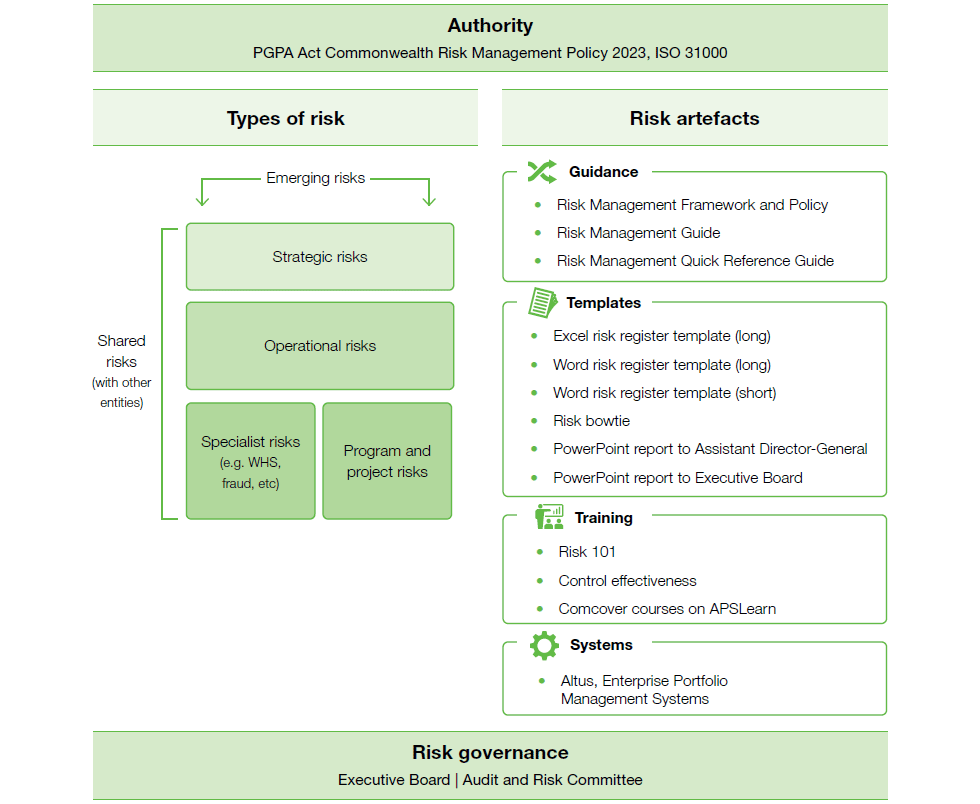
The table below outlines our strategic risks and how we manage them:
| Strategic risk | How we manage our strategic risk |
|---|---|
|
National Archives loses trust, credibility and relevance with its audiences. Australians do not value or engage with the national archival collection. In particular, National Archives fails to connect with First Nations communities and other diverse communities. |
National Archives continues to:
|
|
Agency capability (people, processes, technology) does not meet future requirements. National Archives is unable to develop and maintain the capability required to meet workforce demands, most significantly a workforce that can deliver a digital-first archive with modern ways of working and use of contemporary technology. |
National Archives will:
|
|
Archival material is lost or destroyed. Archival material is lost through failure to identify, secure and preserve material due to resource limitations, obsolescence, neglect or hostile action. |
National Archives continues to:
|
|
National Archives does not adapt its practices, guidance and support to enable Australian Government agencies to meet their information management obligations. This results in Australian Government agencies not meeting their obligations under the Archives Act and in the Building trust in the public record policy to manage the official record of the Commonwealth, reducing public trust in our democratic system. |
The Building trust in the public record policy, which has been extended to 31 December 2028, aims to improve how agencies create, collect, manage and use information assets. This is a shared risk with all Australian Government agencies. National Archives will:
|
|
Delayed public access to the national archival collection. With growing demand for access to the national archival collection, in an environment where resources are limited, requests for access may not be met within legislated timeframes. |
National Archives will:
|
|
Digital archiving practice does not keep pace with rapid technological change. The proliferation of born-digital records requires fundamental changes to archival practice so that records can be ingested, preserved and stored in a way that makes them accessible and secure. |
National Archives is responding to this risk through:
|
Cooperation
Setting information standards across the Australian Government
National Archives is responsible for setting information management standards to guide Australian Government agencies’ best-practice measures to secure, preserve and provide access to Commonwealth records.
A major challenge for National Archives in achieving our purpose is that some agencies do not identify their archival records or transfer those records into the national archival collection. The Archives Act currently lacks an ability for National Archives to enforce compliance to ensure records are appropriately managed.
As a result, we rely on the cooperation of Australian Government agencies to ensure that evidence of government decisions and activities is preserved for future generations.
National and international archival and records management communities
National Archives works closely with regional, national and international archival bodies to address common archival issues and to evolve the role and capability of archives.
In Australia, our work with the archival and information management community includes:
- Australian Digital Recordkeeping Initiative (ADRI)
- Australian Institute for Conservation of Cultural Materials (AICCM)
- Australian Society of Archivists (ASA)
- Australasian Sound Recordings Association (ASRA)
- Council of Australasian Archives and Records Authorities (CAARA)
- Data Management Association of Australia (DAMA)
- GLAM Peak.
National Archives leads the Government Agencies Information Network (GAIN) Australia, a national network that supports agency information and records managers across the Australian Government.
Internationally, we support and participate in skills development, collaborative projects and conferences through bilateral and multilateral relationships. These organisations include:
- Association of Moving Image Archivists (AMIA)
- Digital Preservation Coalition (DPC)
- International Association of Sound Archives (IASA)
- International Council on Archives (ICA), including the Pacific Regional Branch (PARBICA)
- International Federation of Film Archives (FIAF)
- International Federation of Television Archives (IFTA)
- Records and Information Management Practitioners Alliance (RIMPA)
- Southeast Asia-Pacific Audiovisual Archives Association (SEAPAVAA).
Subsidiaries
National Archives does not have any subsidiaries.
Performance measures
The following performance measures articulate National Archives' expected progress towards its outcome to promote the creation, management and preservation of authentic, reliable and useable Australian Government records, and to facilitate Australians' access to the archival resources of the Australian Government.
National Archives will report results against each of the Corporate Plan performance measures and analyse their contribution to the achievement of our purpose in the Annual Performance Statements in the 2026–27 Annual Report. Performance will be assessed using the following ratings:
- Achieved applies where performance measures and targets have met over 95% of their intended outcome.
- Substantially achieved applies where performance measures and targets were not fully met but were substantially achieved and largely delivered the intended outcome. This will be where 75–94% of the target has been met.
- Partially achieved applies where performance has not been substantially achieved but significant progress has been made against the measure. This will be when 50–74% of the target has been met.
- Not achieved applies where 49% or less of the target has been met or where there has been no significant progress against the measure.
Changes to performance measures
The performance measures below have been revised for 2026–27 to better reflect National Archives' current operating environment, priorities and activities.
In previous years, a number of performance measures were informed by Check-up, National Archives' annual information management survey. Check-up has been paused for 2026–27 to undertake a review, ensuring that it is more effective and sustainable for National Archives to operate within available resources. As such, new performance measures have been developed for 2026–27 to reflect National Archives' leadership role in information management and to assess the impact of its activities in this area.
Over the next 4 years, National Archives will strengthen the evidence base used to inform the stewardship of the national archival collection as its scale, formats and complexity continue to evolve. Performance measures relating to collection stewardship have therefore been revised to better align with current collection priorities and support improved assessment of outcomes.
Enable
Key activity:
Provide strategic leadership in best practice information management by Australian Government entities.
| Performance measure E1: National Archives supports improvement in agency information management through targeted and strategic engagement. |
|
National Archives develops policies, standards and supporting guidance to help Australian Government agencies improve how they create, collect, manage and use information assets. National Archives remains committed to continuous improvement of information management within the Australian Government and our contribution in leading that improvement. National Archives works proactively with agencies to address complex information management challenges, mitigate risk and strengthen compliance with the Archives Act. Through targeted advisory, assurance and engagement activities, National Archives supports improvements in information management outcomes for Australian Government agencies. A satisfaction survey is being developed to assess agencies' experience of, and satisfaction with, the assistance and support provided by National Archives on information management issues. Structured case studies will also demonstrate how National Archives' leadership has directly contributed to improved agency information management practices and reduced risk, including by providing disposal authorisations that identify 'retain as national archives' records for future transfers to National Archives and give permission to destroy temporary records to avoid over-retention. |
| Targets | ||||
|---|---|---|---|---|
| Number | 2026–27 | 2027–28 | 2028–29 | 2029–30 |
| E1.1 | Development and implementation of an agency engagement satisfaction survey and baseline data. | Improvement on satisfaction levels on previous year. | Improvement on satisfaction levels on previous year. | Improvement on satisfaction levels on previous year. |
| E1.2 | At least 2 documented case studies per year demonstrating improvement in agency information management outcomes resulting from National Archives' targeted and strategic engagement. | At least 2 documented case studies per year demonstrating improvement in agency information management outcomes resulting from National Archives' targeted and strategic engagement. | At least 2 documented case studies per year demonstrating improvement in agency information management outcomes resulting from National Archives' targeted and strategic engagement. | At least 2 documented case studies per year demonstrating improvement in agency information management outcomes resulting from National Archives' targeted and strategic engagement. |
| Methodology: Performance will be assessed through the satisfaction survey results following establishment in 2026–27, as well as through 2 case studies supported by engagement records, assurance outcomes and documented changes to agency practices. Case studies will be selected to reflect a range of agency contexts and risk profiles. | ||||
Secure
Key activity:
Manage an evolving collection of nationally significant Australian Government information.
| Performance measure S1: Agency capability to identify, prepare and transfer records identified as ‘retain as national archives' (RNA) is strengthened through targeted support from National Archives. |
|
Australian Government agencies are required to transfer records identified as RNA to National Archives once they are no longer in active use. These records form part of the official record of the Commonwealth and support transparency, accountability and access to information. National Archives will prioritise engagement with agencies that have not transferred records for extended periods and may be at greater risk of holding records that are vulnerable to loss, damage or inaccessibility. Targeted support will be provided to improve agency awareness of their obligations under the Archives Act and to strengthen capability to undertake transfers. Each year, National Archives will identify agencies requiring additional support using available data sources, including Check-up reporting, transfer forecasts, RecordSearch and ServiceNow data. Support will be tailored to agency needs and may include advice on appraisal and sentencing, assistance to prepare transfer documentation, and direct engagement to facilitate submission of transfer proposals and item lists. |
| Targets | ||||
|---|---|---|---|---|
| Number | 2026–27 | 2027–28 | 2028–29 | 2029–30 |
| S1.1 | Engage with 2 agencies per year that would benefit from additional support to realise transfer outcomes. | Engage with 2 agencies per year that would benefit from additional support to realise transfer outcomes. | Engage with 2 agencies per year that would benefit from additional support to realise transfer outcomes. | Engage with 2 agencies per year that would benefit from additional support to realise transfer outcomes. |
| Methodology: Performance will be assessed through evidence of improved agency capability and transfer activity for the 2 engaged agencies, specifically agencies submitting transfer documentation that includes a transfer proposal and item list for assessment within the reporting period. | ||||
| Performance measure S2: National Archives safeguards, preserves and manages Australia's archival collection. |
|
National Archives stewards an evolving collection of nationally significant Australian Government information, ensuring it remains secure, trustworthy and preserved for future generations. Over the next 4 years, we will strengthen the evidence base that informs how the collection is safeguarded as its scale, formats and complexity evolve. We will improve and align our collection management activities, including maturing our reporting and metadata practices to better reflect the complexity of the records we hold. This will support long-term preservation, effective management and appropriate access. National Archives will apply best-practice archival and culturally appropriate approaches to enhance the resilience, capacity and diversity of the collection. We will continue to adopt new techniques to manage and care for the collection as it evolves, and provide secure, modern archiving capabilities that seamlessly preserve, manage and enable access to the collection. National Archives prioritises preserving and providing access to the diverse and evolving national archival collection to ensure it remains accessible for current and future generations. Improving our digital preservation practices to safeguard the growing volumes of government records created and managed in digital formats is a priority, as is the continued digitisation of analogue records to support the preservation of at-risk records and to enable access through digital channels. |
| Targets | ||||
|---|---|---|---|---|
| Number | 2026–27 | 2027–28 | 2028–29 | 2029–30 |
| S2.1 | National Archives develops and tests a framework for the active monitoring of digital records in the collection to inform preservation planning and prioritisation. | Baseline metrics and targets for digital collection preservation are established. | Annual digital preservation targets are delivered. | Annual digital preservation targets are delivered. |
| S2.2 | Digitisation targets are delivered. | As per 2026–27. | As per 2026–27. | As per 2026–27. |
| Methodology: Performance will be assessed through the development, testing and endorsement of a risk-based framework for the monitoring and assessment of digital records. Annual digitisation targets reflect the projected deliverables associated with major digitisation projects and partnerships. Specific targets are informed by data from the previous year, with considerations given to the collection's size and overarching preservation and access priorities. Progress against all targets is systematically monitored through data captured in National Archives’ systems. | ||||
Connect
Key activity
Foster access and engagement between people and the national archival collection.
| Performance measure C1: The way audiences engage with and use the collection meets their expectations within a digital-first approach. |
| A key aim for National Archives is to ensure that all Australians are able to meaningfully connect with the national archival collection. We create innovative and audience-centric programs and services to enable onsite, offsite and online access to and engagement with the collection. |
| Targets | ||||
|---|---|---|---|---|
| Number | 2026–27 | 2027–28 | 2028–29 | 2029–30 |
| C1.1 | 70% or more online visits / sessions are engaged. | Same as 2026–27. | Same as 2026–27. | Same as 2026–27. |
| C1.2 | Case studies of programs show that more than 80% of audience expectations were met. | Same as 2026–27. | Same as 2026–27. | Same as 2026–27. |
| Methodology: Reporting on online engagement focuses on the assessment and analysis of online visitor data and engagement metrics. Quantitative data is collected to demonstrate effective engagement with the collection within a digital-first approach. Case studies for 2026–27 are selected at the beginning of the 2026–27 reporting period and represent activities across each quarter to include onsite, offsite and online visitor data that reach a variety of demographics and aim to connect people with the national archival collection. | ||||
| Performance measure C2: The national archival collection is discoverable and accessible. |
|
For records to be of use to the public, they must be discoverable and accessible. For records to be discoverable through our database, RecordSearch, they need to be described accurately using agreed standards. The digitisation of records is also essential to accessibility, as it enables more records to be accessed digitally by more people while preserving the original record. National Archives must also ensure that access applications made by the public are assessed within legislated timetables. Our reference services teams are on hand to help navigate the national archival collection for members of the public. |
| Targets | ||||
|---|---|---|---|---|
| Number | 2026–27 | 2027–28 | 2028–29 | 2029–30 |
| C2.1 | At least 85% of reference enquiries are actioned within service standards. | As per 2026–27. | As per 2026–27. | As per 2026–27. |
| C2.2 | At least 90% of digitisation-on-demand requests are actioned within service standards. | As per 2026–27. | As per 2026–27. | As per 2026–27. |
| C2.3 | At least 80% of access applications are examined within legislated timeframes. | As per 2026–27. | As per 2026–27. | As per 2026–27. |
| Methodology: Reference enquiries and public digitisation-on-demand requests are completed nationally within published service standards, and decisions on access applications are made nationally within the legislated timeframes specified in the Archives Act. | ||||
| Performance measure C3: Engagement with First Nations peoples enables 2-way collaboration and connection with services and collections. |
| National Archives is committed to embedding a First Nations-first approach in all our work. This is supported by Our way: Aboriginal and Torres Strait Islander protocols, which guide our engagement with First Nations communities and peoples, and by the Tandanya-Adelaide Declaration, the first international archives declaration on Indigenous peoples and matters. |
| Targets | ||||
|---|---|---|---|---|
| Number | 2026–27 | 2027–28 | 2028–29 | 2029–30 |
| C3.1 | Case study demonstrates improvement in culturally appropriate record descriptions for First Nations-related collections. | As per 2026–27. | As per 2026–27. | As per 2026–27. |
| Methodology: Assessment of reparative description practices implemented at National Archives, which involves suggesting improvements to record descriptions to be culturally appropriate. The case study is selected at the beginning of the 2026–27 reporting period. | ||||